Antique Maps & Prints of Natural History, Botanicals, & More
Lot 854:
Description
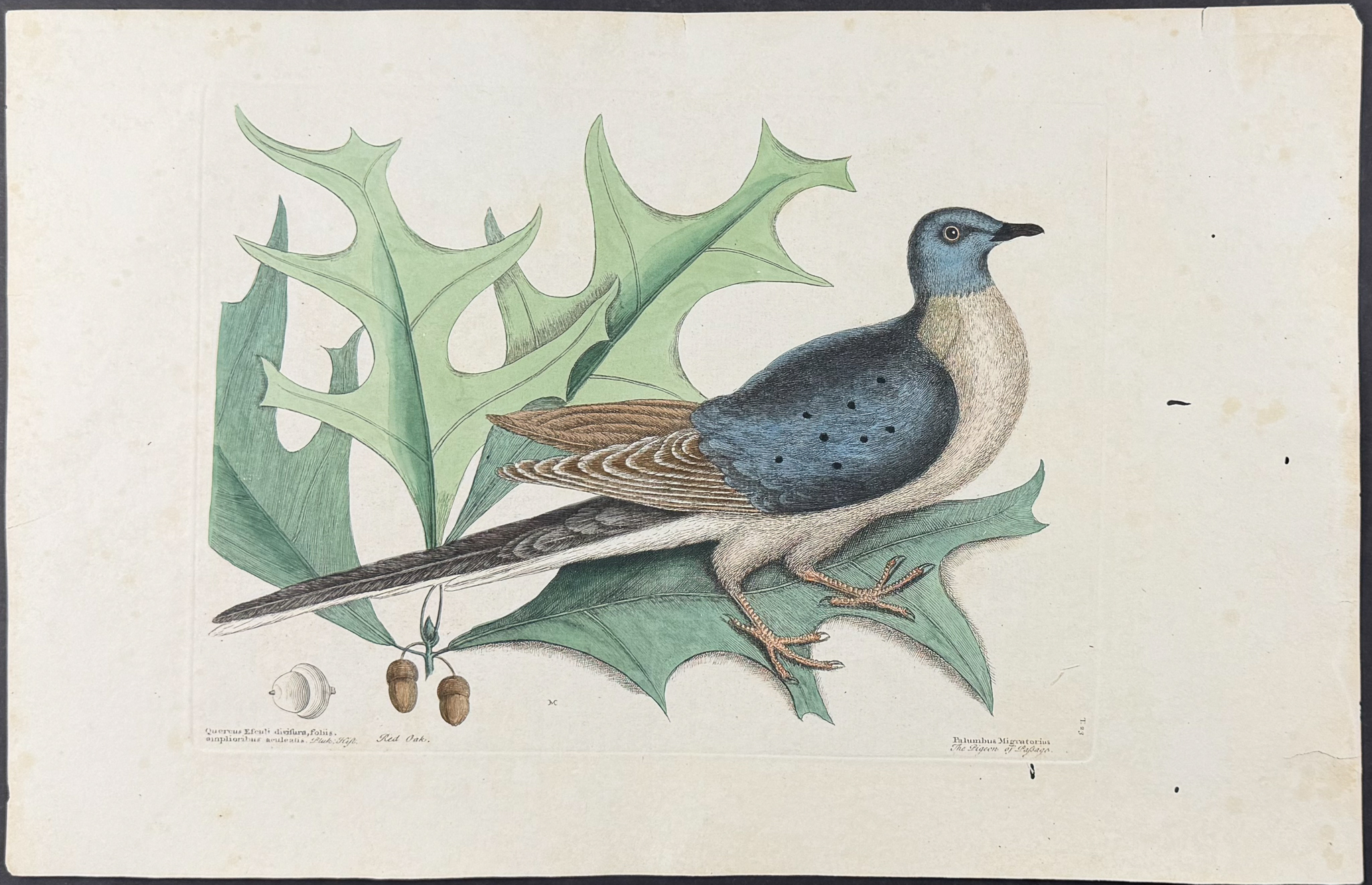
We are pleased to offer this folio engraving from Mark Catesby’s "The Natural History of Carolina, Florida and the Bahama Islands: Containing the Figures of Birds, Beasts, Fishes, Serpents, Insects, and Plants … Together with their Descriptions in English and French". TThis third edition of the work was printed on fine woven paper for Benjamin White in London in 1771.
Mark Catesby’s "Natural History of Carolina, Florida and the Bahama Islands" was the first natural history of American flora and fauna. It is noted as "THE MOST FAMOUS COLOR-PLATE BOOK OF AMERICAN PLANT AND ANIMAL LIFE … It is a delightful and amusing book [and] a fundamental and original work for the study of American species." (Hunt) "Mark Catesby made a valuable and important contribution to ornithological illustration. He was confident enough to break new ground – to portray his birds more naturally than before, with foliage backgrounds, and to adopt the folio format. He depicted the natural history of one area in its entirety, and often drew from living models … AS HIS WAS THE EARLIEST PUBLISHED NATURAL HISTORY OF A PART OF THE NEW WORLD, HE HAS BEEN CALLED THE FATHER OF AMERICAN ORNITHOLOGY." (Jackson)
Mark Catesby was the first American naturalist and illustrator. Though born in England in 1682, Catesby spent several years of his life in the colonies studying the natural flora and fauna. He was so fascinated he produced the first color plate, natural history work on American flora and fauna.
One of the signatures of Catesby’s work is that it incorporates plant and animal life on the same page. Combining the flora and fauna was to save time and money but also began a new style of print composition. He set out to illustrate all the plants, birds, fish, and reptiles in America. His dedication and work greatly contributed to the natural sciences of the 18th century.
"Natural History" was almost entirely completed by Mark Catesby. He did his own field research and sketches. Engravers could not be afforded to get the work to print, so Catesby studied under Joseph Goupy where he learned how to etch the plates himself. The result of his labors is the wonderfully detailed and informative work which gave a glimpse of the world beyond.
Catesby’s work was also the first to abandon the Indian names for his subjects, trying to establish scientific names based on generic relationships. Linnaeus used Catesby’s work as the basis for his system of binomial nomenclature for the American species.
Provenance: Bookplate of Lord Egerton of Tatton; Arpad Plesh (sale at Sotheby’s London on 16 June 1975)
Paper Size: ~ 20 1/2" by 13 1/4"
Paper Type or Special Features: Originally Hand-colored Engraving on Chain-lined, Watermarked Paper
Condition report:
The work is in very good to excellent condition overall. There is a closed tear at the right and left edge well outside the plate mark. There are some worm holes in the lower and right margins. There is faint foxing of the paper, more noticeable to the margins. There may be some extremely faint mottled toning or offset to the paper from this work. There may be a few minor imperfections or faint marks to be expected with age. Please review the image carefully for condition and contact us with any questions.
Share this lot: