Antique Prints, Maps, & Books of Natural History, Botanicals, & More
Lot 2214:
Description
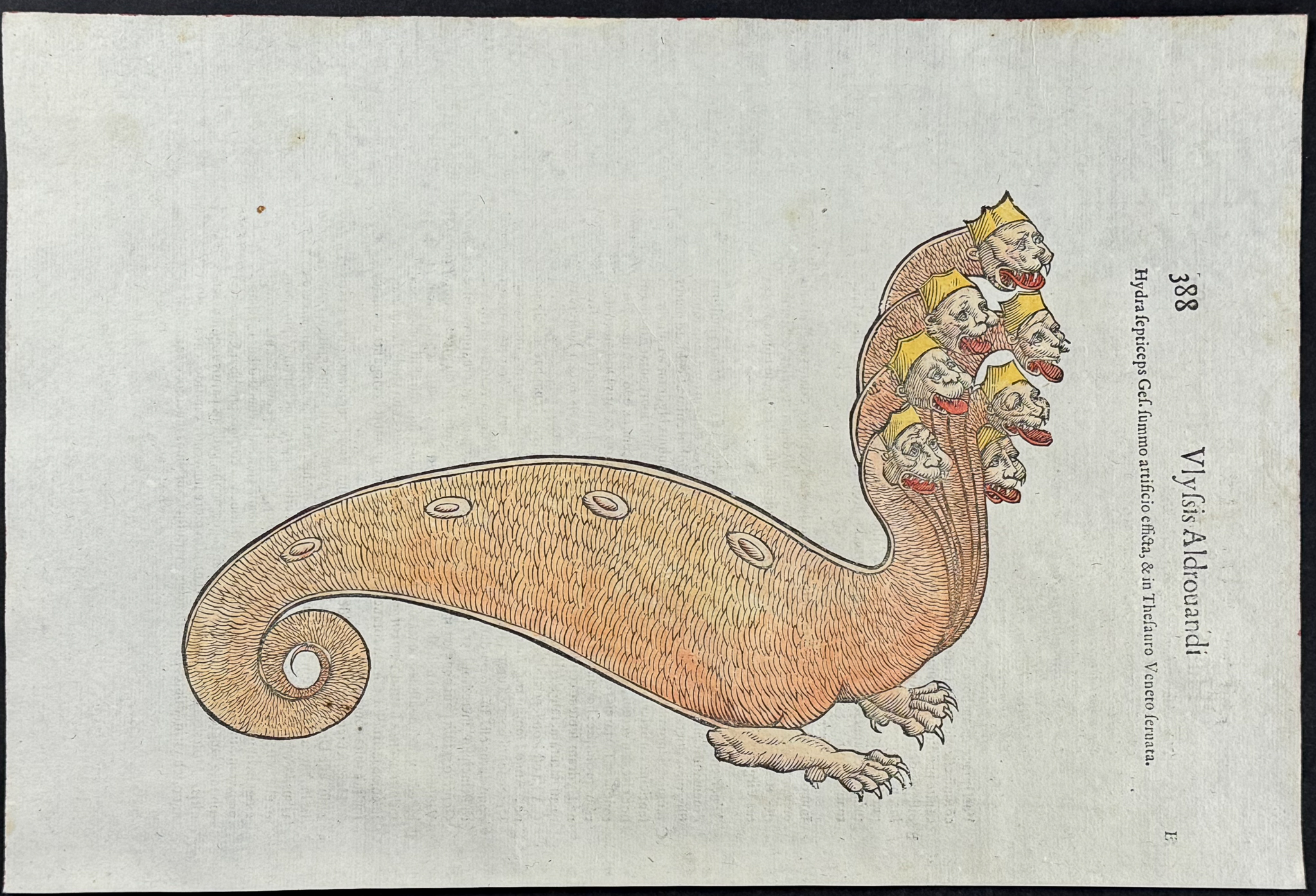
This extraordinarily rare, first edition, folio engraving is from Ulysse Aldrovandi’s
Opera Omnia from the part entitled
Serpentum, et draconum historiae libri duo … The work was published in 1640 in Bologna, Italy by Clemente Ferroni. Many of the illustrations are the work of Jacopo Ligozzi.
Opera Omnia was a massive, multi-volume, natural history encyclopedia. It included the first published image of a toucan and bird of paradise. It was originally 13 volumes in total and featured illustrations of animals, plants, minerals, and fantastic “monsters” including dragons.
Ulysse Aldrovandi (1522-1605) was an Italian botanist, pharmacologist, and noted author. He studied mathematics, Latin, law, and philosophy eventually earning a degree in medicine in 1553. In 1549, on return from studies in Paua, he was arrested in Bologna for heresy and sent to Rome where he managed to exonerate himself, likely due to his parents’ nobility.
Aldrovandi channeled much of his life’s work into collecting, writing and illustrating different biological specimens. His collection is now in display in the University in Bologna. The specimens were classified according to his own system and contributed to the later development of animal taxonomy.
He became a full professor at the University of Bologna in 1561 where he presented natural history as a systematic study. He was also appointed the inspector of drugs and pharmacies, which met opposition, but was confirmed by Pope Gregory XIII. The Pope actually became a benefactor of Aldrovandi’s numerous works on natural history.
Only four of the volumes credited to Aldrovandi appeared in his life time (1522-1605). His students used his manuscripts to complete the remainder of his work. It was the largest collection of natural history illustrations to appear before the 18th century.
“Aldrovandi was aware that the enormity of his task would stretch beyond his lifetime; just as Aristotle had passed his work on to his disciples, Aldrovandi hoped that his own pupils would continue the unfinished business of writing the definitive history of nature. At the end of his life, his literary production -mostly based on the objects of his museum- totaled more than 400 volumes, a number that he claimed would take more than a century to print. ‘And with all this I have kept three scribes in my house, excellent painters, designers, engravers, and have spent much on transportation [of artifacts] and on a library that can stand up to any other particular library in Italy.’ While it is hardly surprising that we should find Aldrovandi’s attempts to bring all knowledge under one roof overwhelming, given our own assumption that there is always more to know, the number and size of his many unfinished projects amazed even contemporaries…
“Separate from the thirteen printed volumes, which covered a range of topics -birds, insects, fish, quadrupeds, serpents, monsters, and hard objects, that is, stones, metals, gems, and fossils- the manuscripts included Aldrovandi ‘s voluminous correspondence, drafts of treatises, tables that classified and tabulated the natural world, and his own encyclopedic compendia that organized all his reading notes alphabetically, topically, and geographically.” (Findlen, Possessing Nature)
The scope and titles of the volumes are as follows:
Vols. I-III. The Ornithology:
Ornithologiae, hoc est, De Avibus Historiae Libri…
Vol. IV. Fishes & Whales:
De Piscibus Libri V et De Cetibus Lib. Unus.
Vol. V. Monsters:
Monstrorum historia cum Paralipomenis historiae omnium animalium
Vol. VI. From Dogs to Chameleons: The “Clawed” Quadrupeds:
De Quadrupedib. Digitatis Viviparis Libri Tres, et De Quadrupedibus Digitatis Oviparis Libri Duo. Bartholomaeus Ambrosinus… collegit
Vol. VII. Cloven-hoofed Quadrupeds:
Quadrupedum omnium bisulcorum historia
Vol. VIII. Solid-hoofed Quadrupeds:
De Quadrupedibus solidipedibus volumen integrum, Joannes Cornelius Uterverius, collegit et recensuit. Hyeronimus Tamburinus in lucem edidit
Vol. IX. Marine Invertebrates:
De Reliquis Animalibus Exanguibus Libri Quatuor, nempe de Mollibus, Crustaceis, Testaceis, et Zoophytis
Vol. X. Snakes & Dragons:
Serpentum, et Draconum Historiae Libri Duo
Vol. XI. The Botanical Collection:
Dendrologiae naturalis scilicet arborum historiae libri duo sylua glandaria, acinosumque pomarium vbi eruditiones omnium generum unà cum botanicis doctrinis ingenia quaecunque non parum iuvant, et oblectant Ovidius Montalbanus
Vol. XII. Insects:
De animalibus insectis libri septem
Vol. XIII. Metals & Minerals, including Fossils:
Musaeum Metallicum
Provenance: Eduardo Obejero Urquiza, lithographed bookplate was present to front paste-down
Paper Size: ~ 9 1/2" by 14"
Paper Type or Special Features: Woodcut Engraving with Professional Hand-coloring
Condition report:
The work is in very good to excellent condition overall. There may be a few minor imperfections to be expected with age. Please review the image carefully for condition and contact us with any questions.
Share this lot: