Antique Maps & Prints of Natural History, Botanicals, & More
Lot 5026:
Description
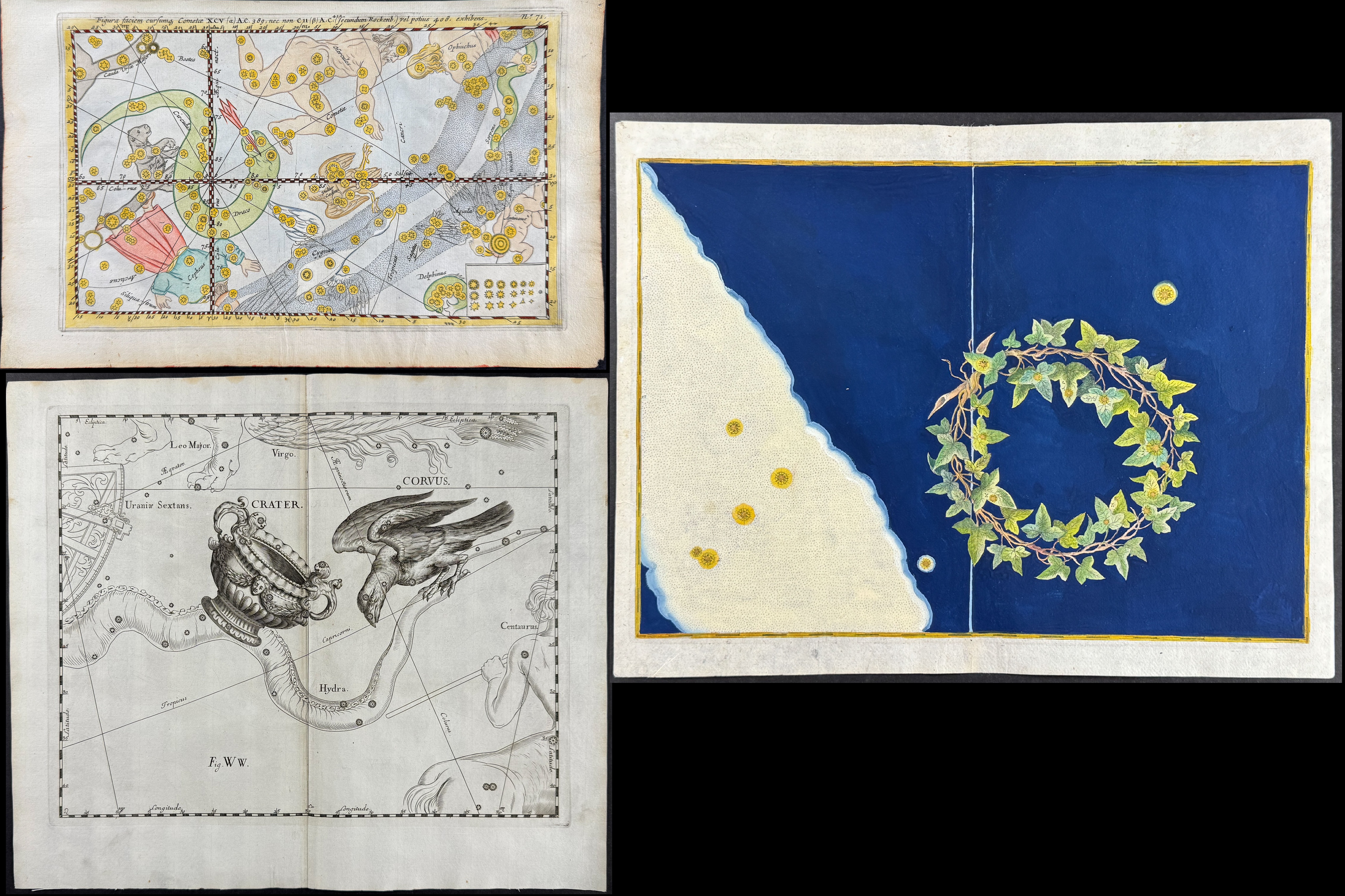
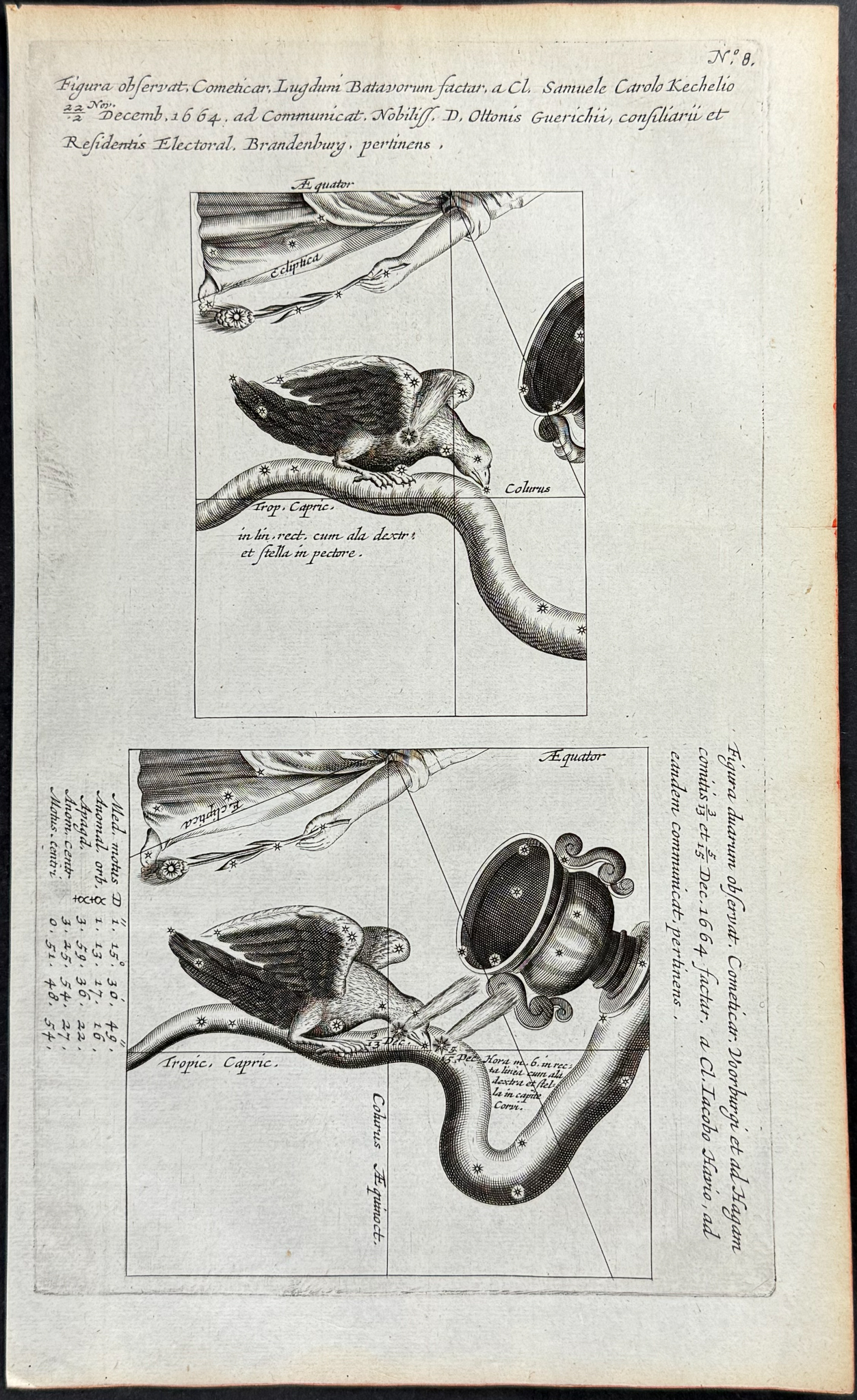
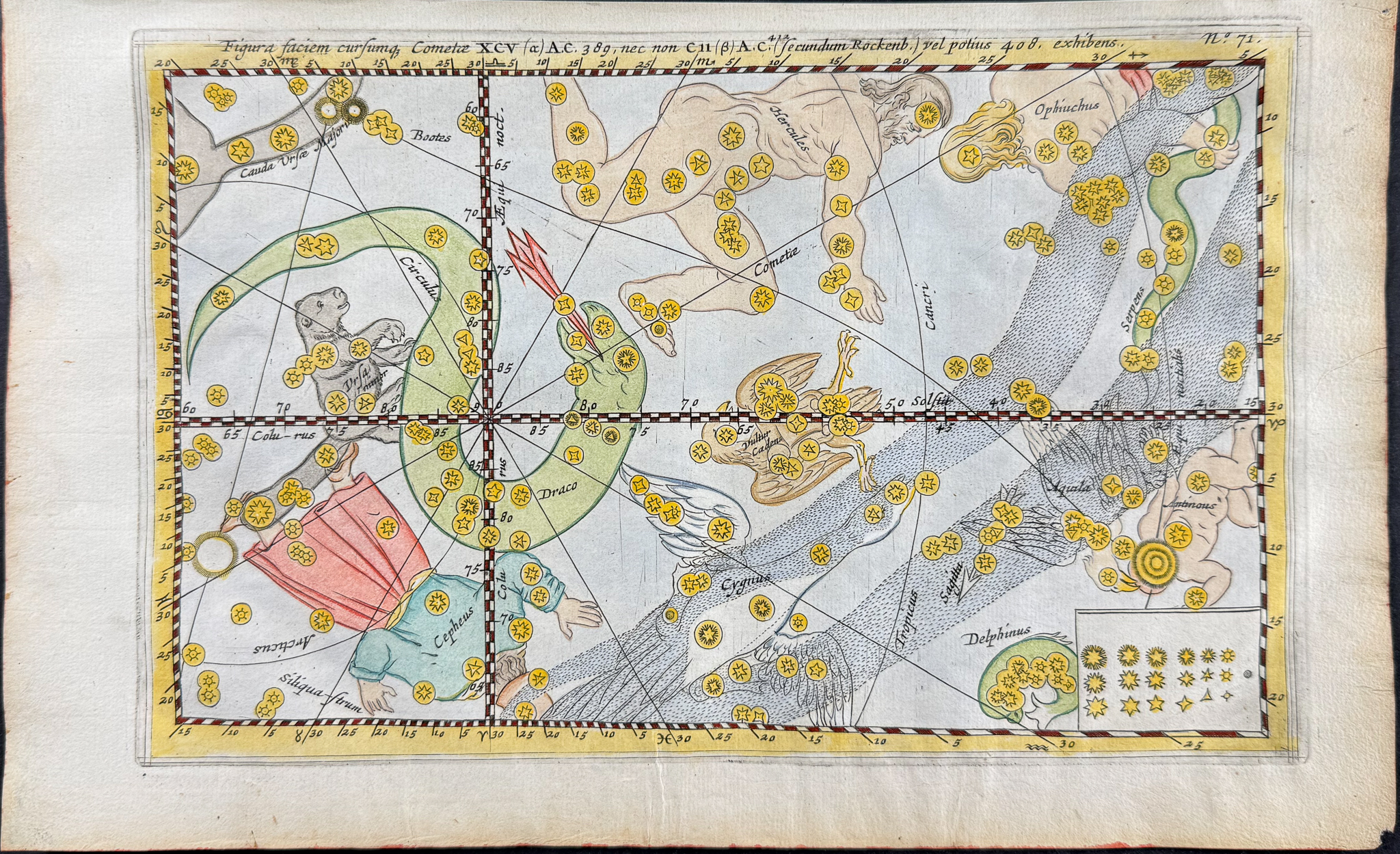
Two Engravings from Lubieniecki:
This fascinating celestial engraving is from Stanislaw Lubieniecki’s
Theatrum cometicum, duabus partibus constans. The work was published in Leiden by Pieter van der Meersche in 1681.
The work included several celestial engravings depicting constellations, orbits, comets, and more. The engravings were completed by Stopendaal, Gerardi, Gerritsz, and others after illustrations and observations by M.C. Isenius and others. Lubieniecki corresponded with several leading astronomers of the day to compile this work including Guericke, Hevelius, and Schott.
"Since each map represents the observations of a different astronomer, taken together they illustrate the variety of cartographic traditions popular during the seventeenth century. On many of the maps the choice of constellations, of constellation style, and of constellation names are strongly reminiscent of the celestial globes of Blaeu and Hondius. Several other maps carry the Judeo-Christian constellations introduced by Plancius. From Rome, Kircher sent a map derived from those of Grienberger. On only a few maps are the stars identified by Bayer letters. None of the maps reflects any of the traditions popular during the previous century." (Warner, The sky explored, p 164)
Stanislaw Lubieniecki (1623-1675) was born in Rakow (now in Germany). He studied astronomy, with a particular focus on comets. He also completed a work on the Polish Reformation entitled Historia Reformationis Polonicae.
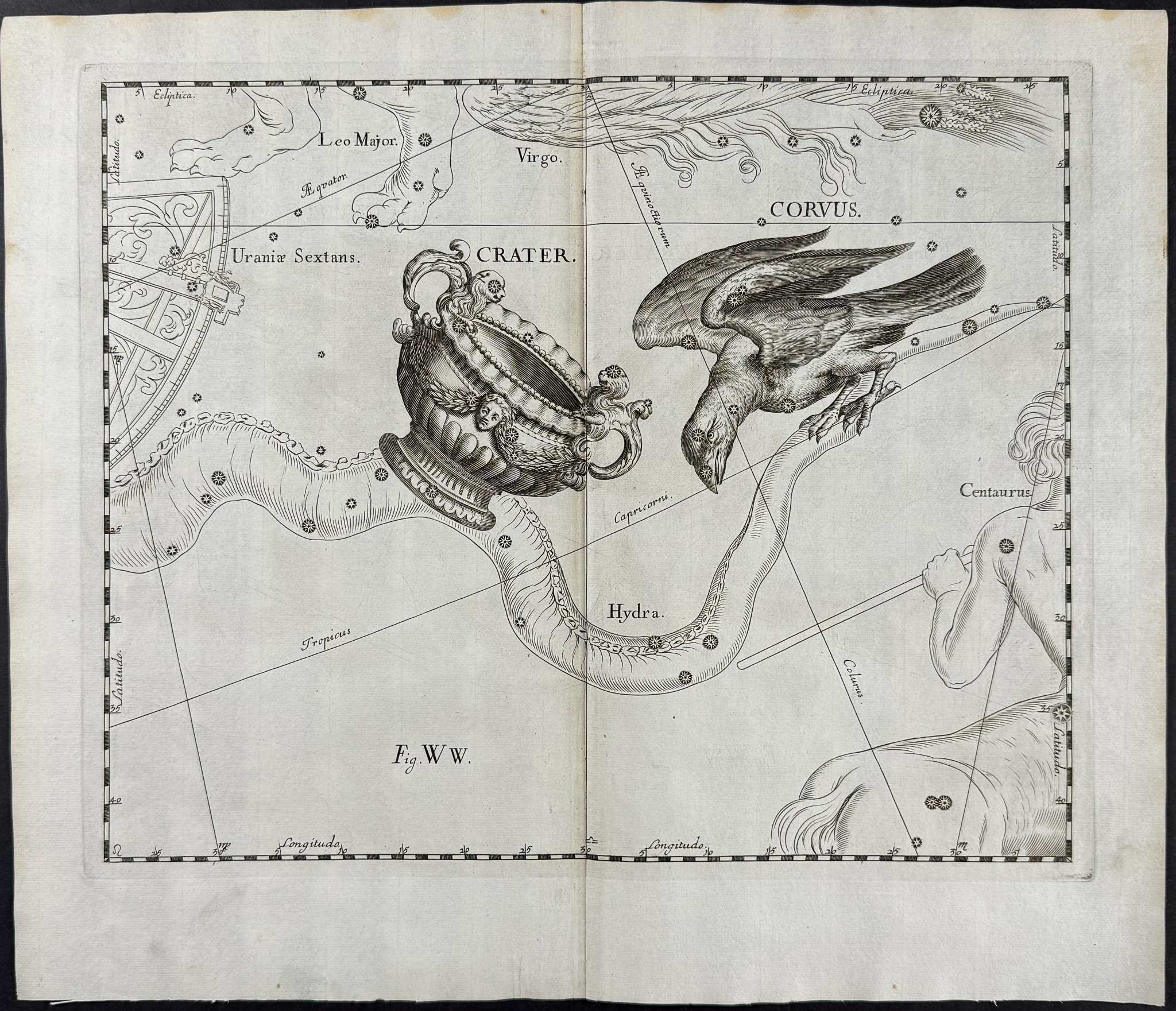
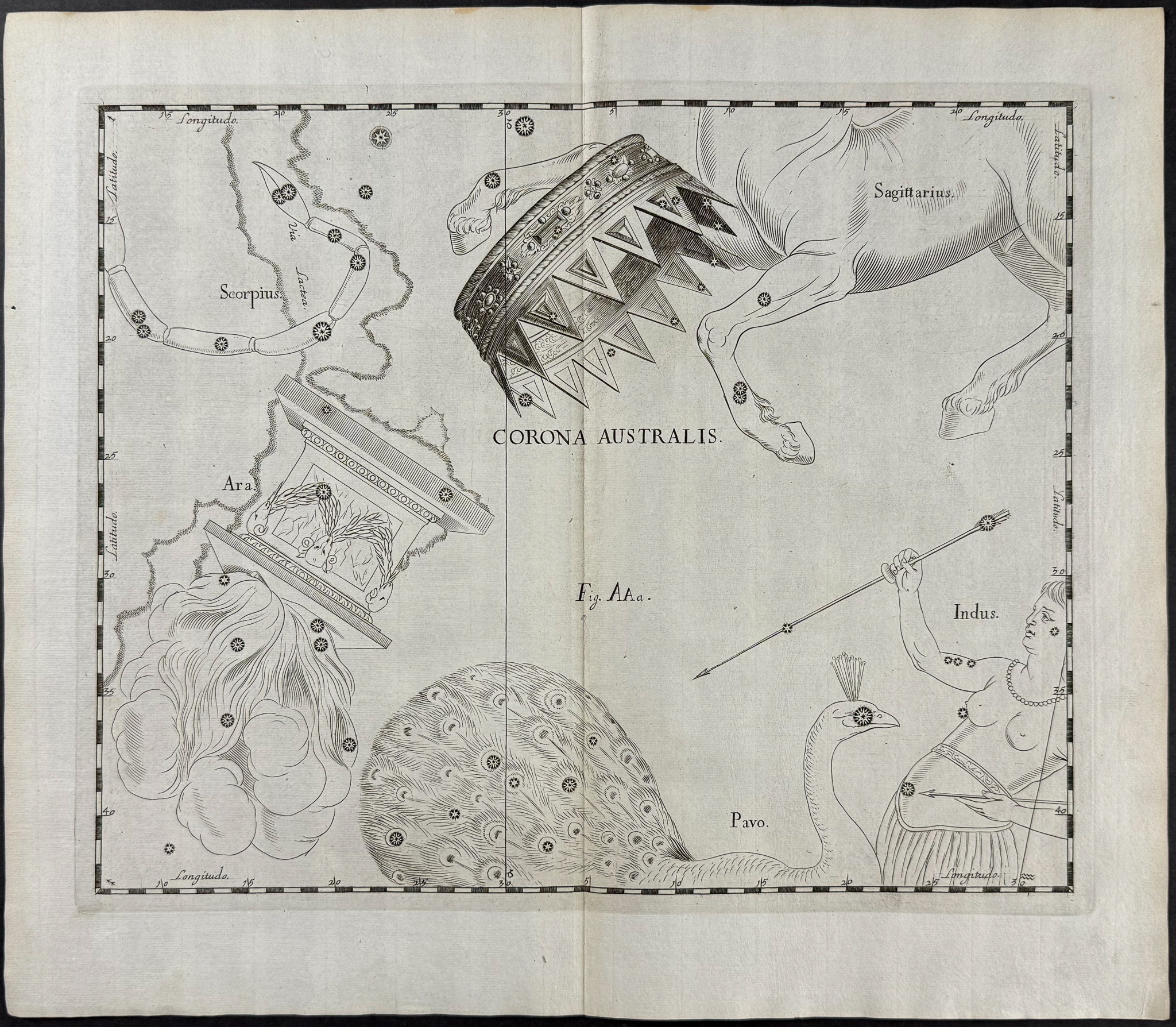
Two Engravings from Hevelius:
This rare first edition engraving is from Johannes Hevelius’s
Prodromus Astronomiae, exhibens fundamenta, quae tam ad novum plane & correctiorem stellarum fixarum catalogum construendum. The work was published in Danzig in 1690 by Johann Zacharias Stoll. The maps were drawn by Andreas Stech and engraved by Charles de la Haye and believed in part to be done by Hevelius as well.
Johannes Hevelius (1611-1687) was a Polish-Lithuanian astronomer. He gained the epithet "the founder of lunar topography." He built an observatory named Sternenburg featuring a large Keplerian telescope. He received patronage from four Polish kings. This work was published poshumously by his widow, Elisabeth (considered the first female astronomer), and includes an introduction from her. The
Prodromus astronomiae manuscript was one of the few items saved from the 1679 fire at Hevelius’s home observatory.
Warner describes Hevelius as “An outstanding astronomical observer whose private observatory in Danzig (Gdansk) was for many years the best in Europe…” (Warner, The Sky Explored) Hevelius introduced eleven stars including Scutum Sobiescianum (The Shield of Sobieski), the Lynx, and the Sextans (named after the tool he designed).
Prodromus astronomiae "is by far the most widely known of [Hevelius’s] compendia of observations. … It is a catalogue of 1,564 stars arranged alphabetically under constellation names and by stellar magnitude within constellations. Latitude, longitude, right ascension, and declination are given. … Hevelius named eleven new constellations formed of stars not included in earlier groupings; seven of these names are still used." (DSB)
The star atlas was unique in that it was done by a working astronomer and thus depicted "the constellations as they would appear on a globe, that is, from the outside looking in, rather than from a geocentric point of view, as Bayer and most others adopted." (Linda Hall) His observations were adapted by his contemporary globemakers including Eimmart, Gerhard, and Valck.
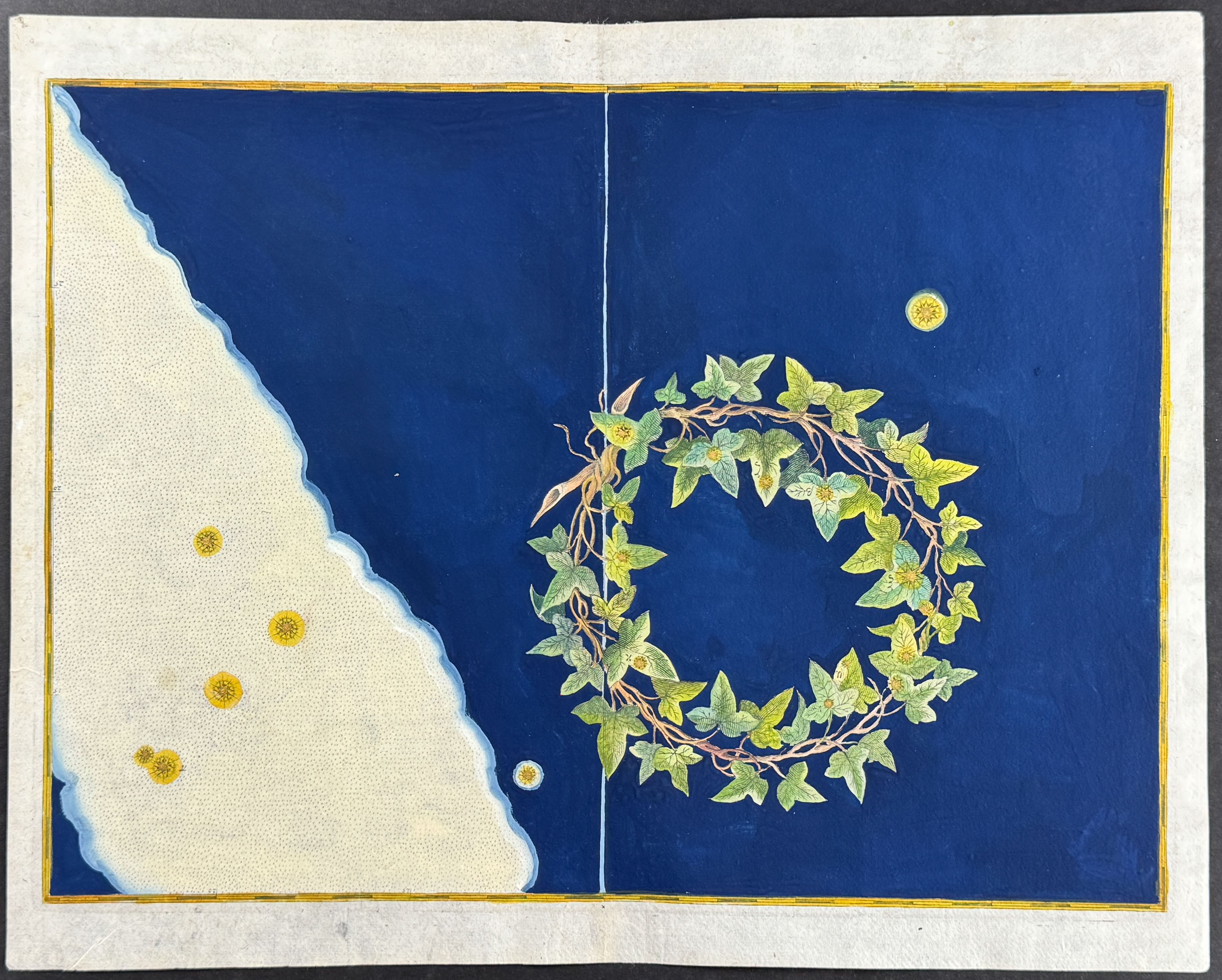
One Engraving from Bayer:
Perhaps the most influential book in celestial maps, Johann Bayer’s
Uranometria set long-lasting standards in the world of astronomy. Most importantly, this was not just a book of pictures of the skies, but a map of them, an atlas. The engravings for the work were completed by Alexander Mair. This particular engraving is from the 1600s, likely published in 1609 or 1603 by Christoph Mang et al in Ulm, Germany. The first edition of this work was the only one with a dated title page and printed on vellum. This engraving is on chain-linked paper without the text to verso indicating it was a 17th century publication of the atlas.
Bayer included a carefully engraved grid so that the maps could be read and followed to a fraction of a degree. Also, Bayer was the first to us Greek letters to designate stars, commonly in order of magnitude. From that, he named the stars using the Greek letter he had given it coupled with the constellation name, i.e. alpha Tauri.
Bayer’s work opened a new age in the history of celestial cartography. It was also the first work to represent the stars around the South Pole. The work represented the stars and their positions as presented in Tycho Brahe’s catalogue. Bayer also included a plate depicting 12 new southern constellations discovered by Dutch navigators, Peter Dirckszoon de Keyser and Frederick De Houtmann.
The recently applied, professional hand coloring is of very high quality. The sky, grid lines, and gold image border are colored using gouache, which is a type of paint consisting of a high ration of pigment to water along with an inert material, such as chalk. Gouache is heavier and more opaque than traditional watercolor. The pictorial constellations themselves are painted with watercolor, allowing the paper and star symbols to show through. The stars have been painted in luminous silver or gold which reflects light.
Paper Size: ~ 12 1/2" by 7 3/4"
~ 17" by 14 3/4" (Fold Out)
~ 12 3/4" by 15 1/2"
Paper Type or Special Features: Engravings
Condition report:
The work is in very good to excellent condition overall. There may be a few minor imperfections or faint marks to be expected with age. Please review the image carefully for condition and contact us with any questions.
Share this lot: